

While last week’s article focused on Green candidate Josh Jacobsen’s Afghanistan service, previous allegations have also resurfaced. They surround Josh’s connections and work history following his service, and that his arrival at the months-long 2021 Pūtiki occupation was connected to the massive police raid that followed just days later.
They also allege that Josh continues to serve a role either directly or indirectly with his entry into the Green Party, most notably through the division he’s created and the ongoing normalisation of the military through his presence in the party. Like the questions over Josh’s service, these have remained unanswered.
So alongside the previous article, here is Josh’s record that the Greens decided to sign off on. Whether or not you think Josh has adequately severed his ties to the world he inhabited as a Global War on Terror special forces soldier, both Josh and the Greens have instead danced around this history.
The Greens have still not adequately explained why they’re running a candidate now going out and pitching questions on “soldiers as workers” at debates for the Greens’ foreign policy spokesperson Teanau Tuiono during the buildup to the brewing Second Pacific War.
Post-service
According to Jacobsen’s LinkedIn and subsequent bios, over 2008 to 2013 (before, during, and after serving in the SAS) Jacobsen attained a BA majoring in Defence Studies and Politics from Wellington’s Massey University. He learns Pashto then Arabic seemingly while deployed, and Spanish and French “during his travels”. He spent the first half of 2012 studying abroad at California State University, where he participated in a Model UN Far West Conference. This conference is implied in Jacobsen’s New Zealand Herald profile to be where he first met his wife, Lauren Peate, whom Josh asked not to be named.
Lauren is one of three daughters to Dr. Wayne Peate and Dr. Lynn Struthers. Wayne was born in Arizona’s Davis Monthan Air Force Base, later becoming a scholarship medical student at Harvard, Stanford and Dartmouth. He then volunteered to provide medical relief during the Somali Civil War for 60,000 refugees, becoming a Lieutenant Colonel in the US Army Reserve Medical Corps. Wayne is also an associate professor and cancer researcher at the University of Arizona, and his company WellAmerica provides healthcare to fire departments and Pima County SWAT.
According to her LinkedIn, Lauren studied economics at Stanford from 2007 to 2011, minoring in Arabic. She spent her 2007 summer in Nicaragua on a Stanford grant as a health intern, the same year that long-time left-wing leader Daniel Ortega returned to power in 2007. In 2011, she studied in Morocco as part of an Albright-funded research study on the “economic empowerment of women survivors of violence”, a year in which the country was rocked by Arab Spring protests. After her time in Morocco, Peate in July 2011 began working for Bain & Company, one of the “Big Three” American consulting firms, based in San Francisco from 2011 to 2013 “advising Fortune 500 tech companies”.
In 2012 during his studies, Josh volunteers at a Bolivian language academy for an hour a night, a year which saw dramatic turmoil against Evo Morales’ second-term government. In late 2013, Peate takes a sabbatical to work at a Jordan-based startup mentorship non-profit, before leaving Bain to work at the Arabic world’s largest online bookstore, also in Jordan, starting in January 2014. Josh says he followed her there, as after finishing at Massey it’s the same month he starts as a Safety and Security Advisor for UNRWA in Jordan, managing Palestinian refugee camps and UNRWA-ran schools.
In September 2014, Jacobsen starts a year-long contract as a Field Security Support Officer in Gaza, writing on his LinkedIn that he “led and managed the 1260 people in the Safety and Security Division in Gaza”, was “responsible for the safety of over 12,000 UNRWA staff … [and] almost 300 installations”, and reported to the Director of Gaza’s UNRWA Operations. In March 2015, Lauren starts a year-long contract working as a mentor for Gaza Sky Geeks, a Google and Microsoft-backed NGO that operated as a Gazan startup accelerator. As well as working with Saudi company Fullbright to “coach young professionals on entrepreneurship & business skills” travelling to Riyadh and Kuala Lumpur, while still living and working in Gaza.
Homecoming
Josh and Lauren moved to Auckland in 2016, with Josh listed as co-director for Desert Road Project Management Limited in May 2016 alongside fellow NZDF Afghanistan veteran Justin Tunnage. Desert Road Group (DRG), according to one of Josh’s later bios, provides “security consulting, project management, and risk management services to public and private sector organisations looking to manage risks to their staff and operations.”
The company’s namesake is the stretch of State Highway 1 that passes through the Rangipo Desert, which also serves as the NZDF’s primary live-fire training area. Jacobsen left the company in November 2017, and today DRG’s website lists the NZDF, the Ministry of Defence, NZ Police, MBIE, Customs, and Inland Revenue as clients. Justin, Josh’s co-founder, has made multiple LinkedIn posts asking for a “conversation about New Zealand’s nuclear stance” and won a NZ military writing competition with a piece about night vision goggles.
In 2016, Lauren co-founds the short-lived Analytics for Us, alongside beginning a number of roles like at the Ākina Foundation, an advisor role at a women-led books and movies promo startup, and entrepreneur program advisor at the University of Auckland’s Centre for Innovation and Entrepreneurship. She also worked at the Edmund Hillary Fellowship as a Candidate Attraction Lead, an initiative launched by the American expat Monahan Brothers to give “global impact” visas to entrepreneurial candidates.
In February 2017, Josh began working for NZ accounting company Xero, his first software role. In 2017, Lauren Peate founds Ally Skills NZ, a diversity and inclusion consulting and workshop company, and joins as an advisor on the Good Data Institute in 2019. In June 2020, Lauren founded her current company, Multitudes, a startup focused on AI agent analytics for software engineering.
In March 2019, Jacobsen is quoted in Newstalk ZB and The Spinoff as a ‘Defence Force veteran’ representing the organisation Gun Control NZ, and is credited for starting a petition to ban semi-automatic weapons in the wake of the Christchurch massacre.
Josh left Xero in late 2019, working as a developer for My Food Bag until 2021, before starting as a senior software engineer at telecom company Vital until 2022. Jacobsen also lists himself as having learnt te reo Māori after returning to Auckland. Josh’s Instagram has posts that date back to 2019, including one post at a BLM protest in June 2020.
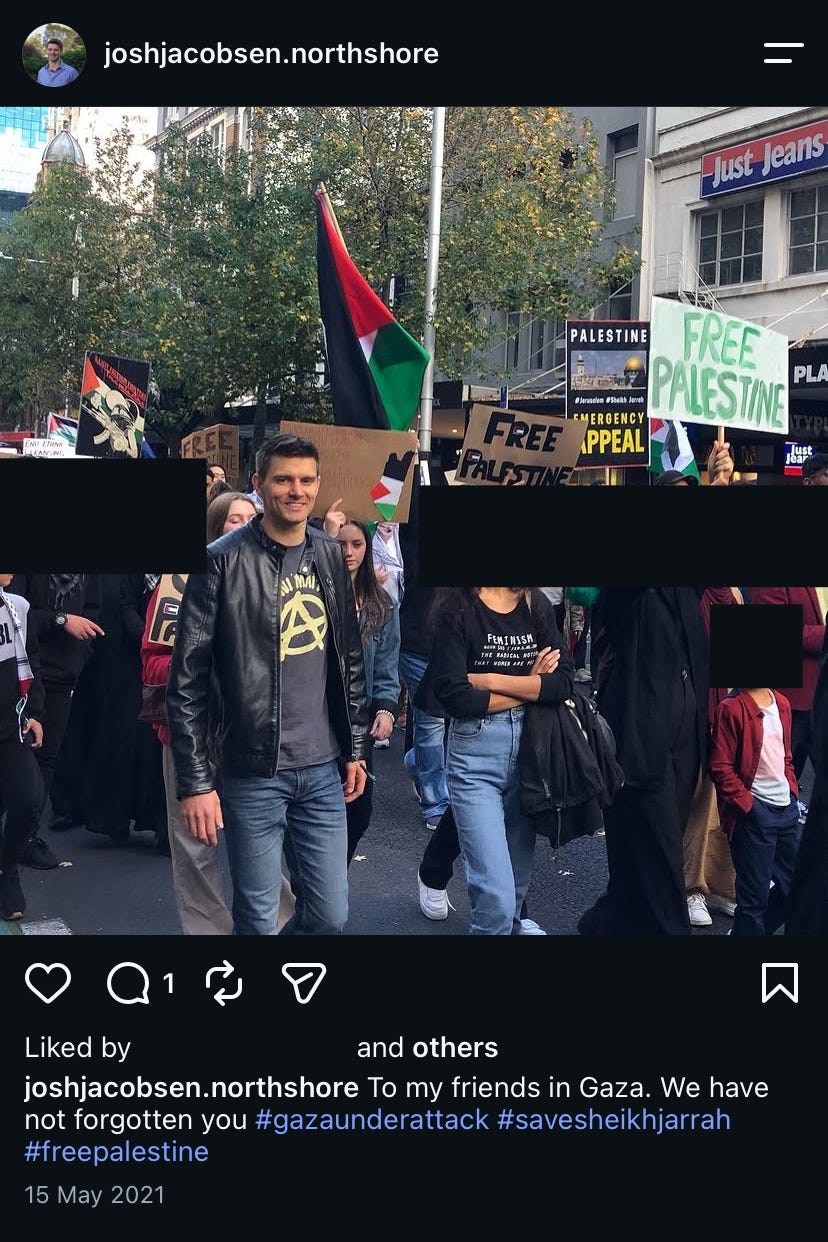
At some point in 2021, he restarts his Facebook account, and in May he posts a photo of himself at a rally for Palestine during the 2021 Israeli strikes on Gaza. And two months later, Josh Jacobsen shows up at the Pūtiki Bay occupation.
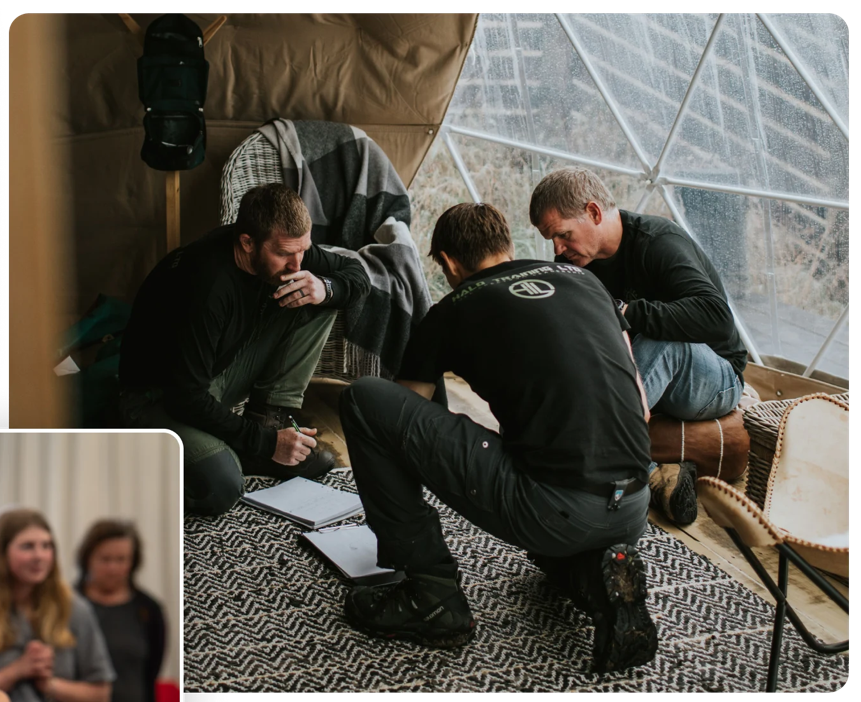
According to Josh, Desert Road Group was his last military-related endeavour. However, one company that Jacobsen doesn’t list was his time at HALO Training, a Queenstown company founded in 2018 (h/t @bigdumbbuffoon). Named after the SAS tactic of ‘High Altitude, Low Opening’ parachute infiltration missions behind enemy lines, HALO offers typical “combat-inspired” programmes for leadership and team-building exercises, touting their veteran (or actively employed) staff to show their experience.
HALO’s founder, Australian-born Tony Groves, started his career with a decade in the Australian Intelligence Corps until 2007. He then left to work for notorious private military company DynCorp International in Afghanistan and Iraq between 2007 and 2011, under contract to the US State Department’s highly secretive Bureau of International Narcotics and Law Enforcement Affairs. He then joined security services and cash management company GardaWorld, and was under contract to the same Bureau in Afghanistan until March 2013.
Tony and his wife Maria Topia-Groves (who now bills herself as a private investigator on LinkedIn) started HALO Training in 2018, with Josh being listed as an employee on the website from 2019 onwards. By January 2021, he was working alongside the psychologist who’d been deployed alongside the NZSAS in Afghanistan, and a member of the New Zealand Intelligence community referred to only as “Mel”. Josh was removed from the website’s team list in late 2022, but you can still see him on their homepage today.
What makes the fact that Josh doesn’t list this role strange is that it overlaps with the time he first properly entered left circles, complicating the story that’s been told of a soldier who turned to software development in 2017. And it overlaps with the time he inserted himself into the tumultuous 2021 Pūtiki occupation.
Pūtiki
In 2017, community opposition to a proposed 180-berth marina in Waiheke Island’s Pūtiki Bay resulted in the formation of the Save Kennedy Point group, which embarked on a 4-year legal battle against the plans, with a final appeal rejected by the Supreme Court in 2021. With no other legal avenues left, Protect Pūtiki protesters began occupying the construction site that March.
Throughout the legal battle, the marina developers had contracted private security firms to deal with the opposition, as many firms both public and private are known to do, but stepped up as the occupation commenced. These private security staff were not subject to the same public scrutiny as police and would harass, intimidate, and violently assault Pūtiki protestors, with incidents escalating over the occupation. Tensions came to a head on 7 July with a fight over the construction pontoon, with the protestors subsequently occupying it.
One contractor, Hal October, convicted of kicking a protestor in the face and holding him in a headlock for a minute during the fight, lists time between New Zealand and the Middle East since the 2000s as a security contractor. Hal’s conviction was later overturned on appeal without the protestor being informed.
He’d created KAITIAKI PROTECTION LIMITED in May 2019, named after the te reo name the protestors referred to themselves as meaning “guardians of the area”. The other companies hired for security included Warden Consulting, who boasted on their website in 2021 having “35 full-time staff members” with ex-police on payroll and the ability to do “surveillance and undercover operations”.
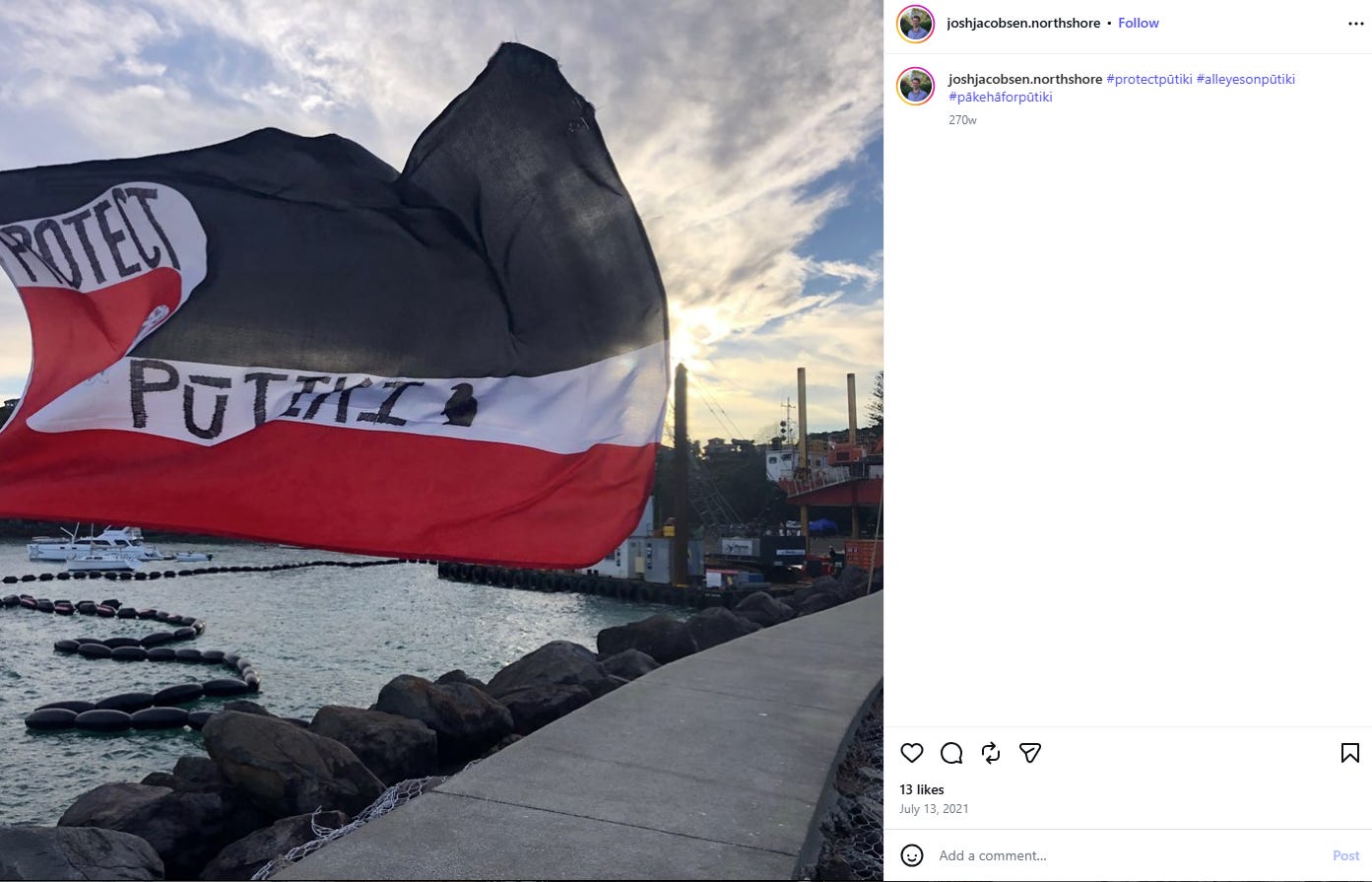
Just a few days after the pontoon fight, Josh Jacobsen showed up to join the occupation. He said at a September 11 Q&A heard by Exit From Affco that his politics had gradually changed since he left the NZSAS, but Pūtiki was his first time really engaging on the organised left. A number of those involved in Pūtiki were suspicious of Josh from day one, being a Pākehā man they’d never met now inserting himself into an ongoing tightknit community movement, and especially after they Googled him and found his SAS record.
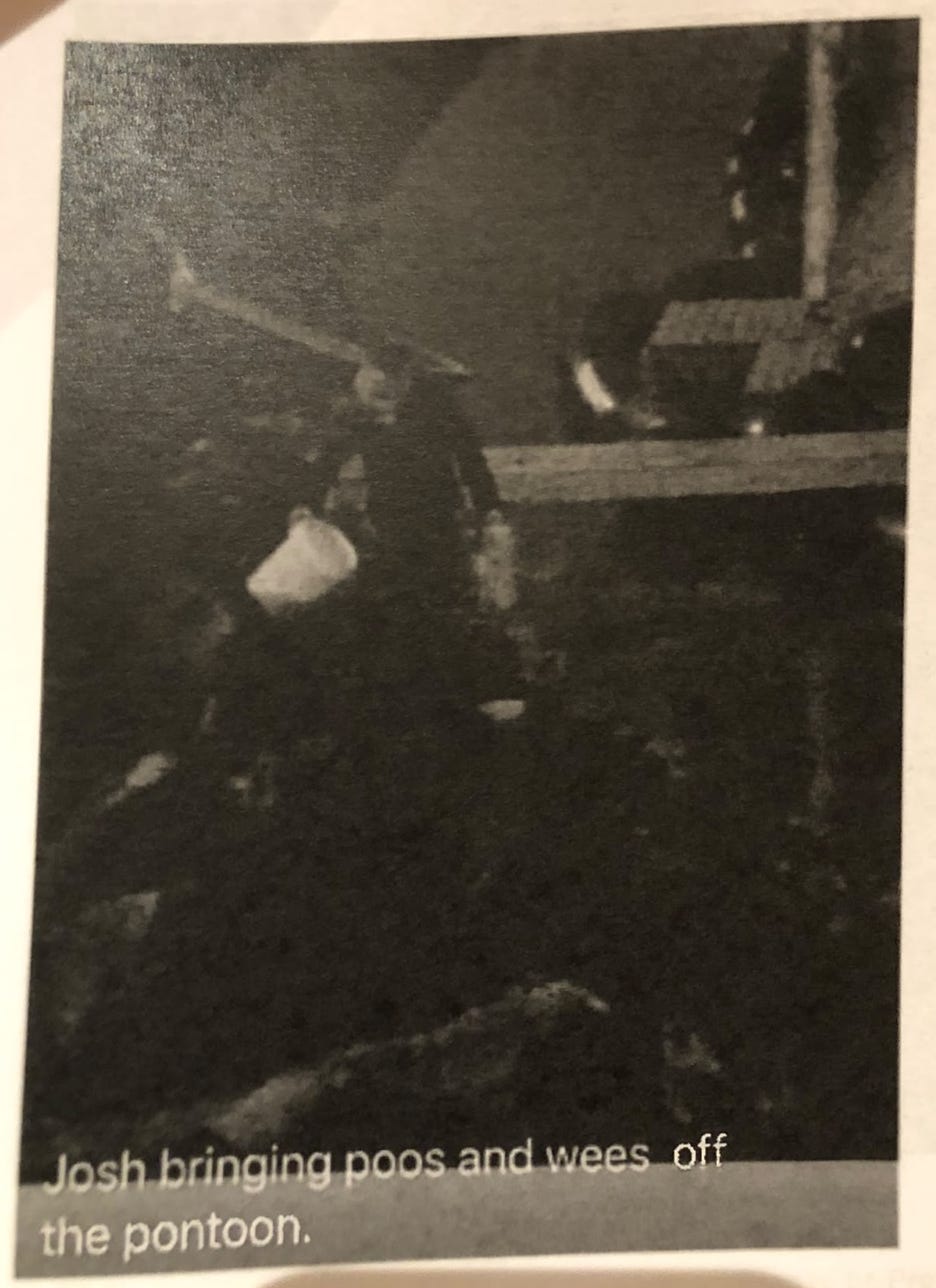
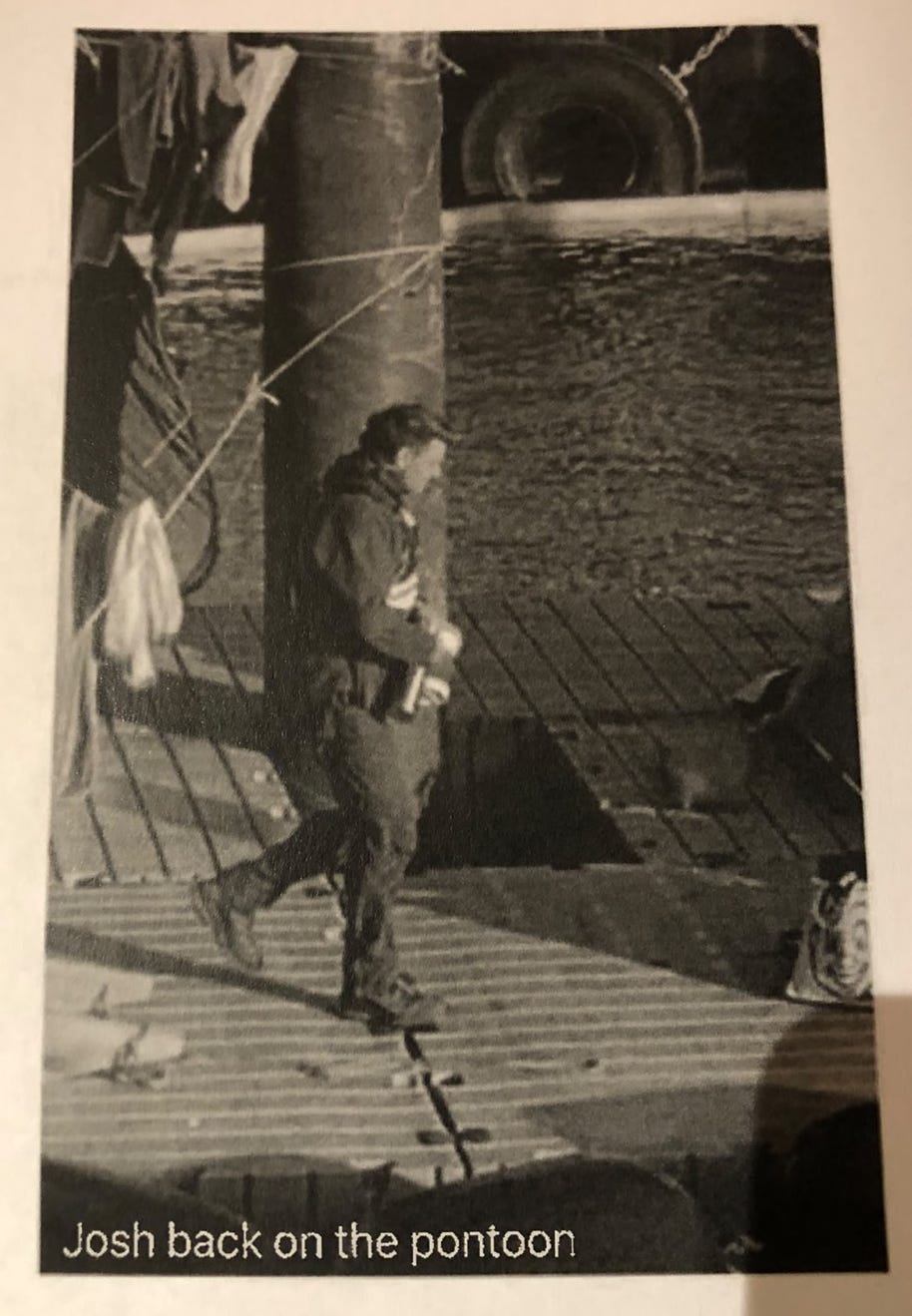
He did manage to find some who got along with him, and soon joined the protestors occupying the pontoon. A few days later on 15 July, a massive police raid descended involving dozens of officers, four police boats, a police dive squad, and the Eagle helicopter. They arrested the three on the pontoon at the time, including Josh, and a protestor on a nearby construction rig.
Josh is in the second video being led away centre-frame by the cops. Josh in the following days began posting about his trial on Facebook and Instagram, setting his banner to Pūtiki. His first court appearance on wilful trespassing charges was 30 July 2021.

The next month, he posted about being denied legal aid due to an inability to present “evidence that you cannot borrow to fund your own lawyer”. To pay for his legal fees, Josh instead used $20,000 from a $76,000 Givealittle fund established to support Protect Pūtiki. His case took 3 years to process, with him later being discharged without conviction on his second appeal.
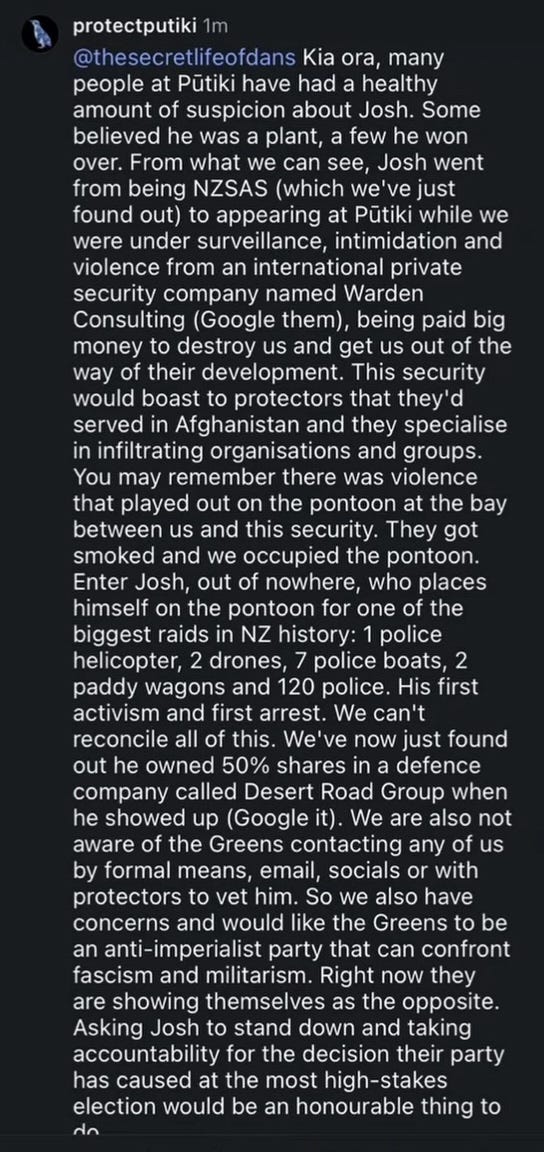
Protect Pūtiki leadership have made allegations of Josh serving some sort of plant role in the protest, citing the private security deployed against the protests, Josh’s background, the timing of his arrival with the raid, the severity of the police response, and his lighter treatment on arrest and in court.
Some involved in the occupation have instead disputed these allegations and stood alongside Josh following the raid, and the dispute has been contentious amongst the Pūtiki community, and subsequently the wider Auckland left.
In 2022 Josh joined Cogo as a senior software engineer, a carbon footprint tracking software company. In 2024, Josh then joined Multitudes, Lauren’s startup, as lead software engineer. At some point in the last few years, Josh got involved with the North Shore electorate’s Green Party chapter, soon becoming co-chair.
He put his hat in the ring in 2025, went through the party’s selection process, then went to the candidate ranking conference in February this year covered in Part 1. When the Green candidate list based on delegate voting was released in March, Josh was ranked 25th out of 35th. Some have used this low position as a defence for his selection, but that list can often change quickly with the Greens.
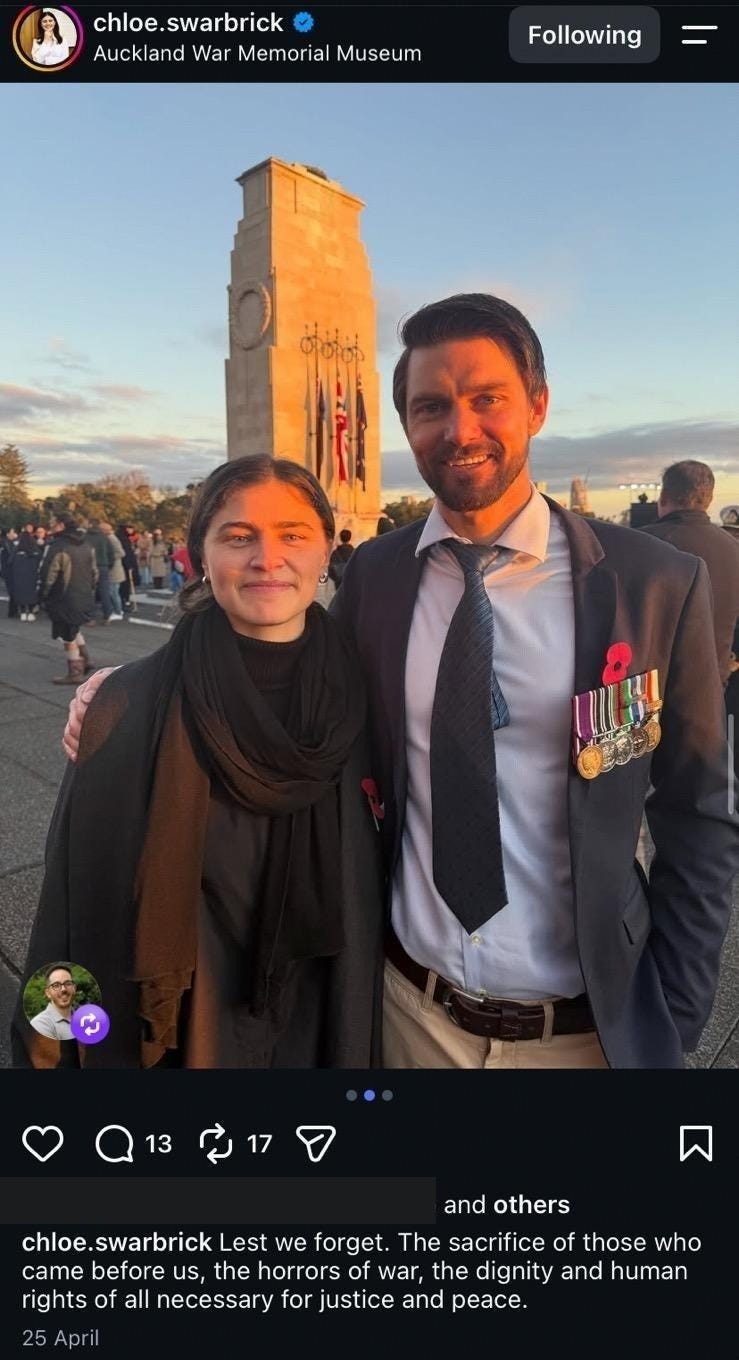
In April, Green co-leader Chlöe Swarbrick attended the Auckland War Memorial Museum’s ANZAC Day ceremony with Josh, posting a photo of them together.
Questions
Considering the response to the previous article, especially amongst Green supporters, this article will likely raise more questions about Jacobsen’s record. Ones posed to the Greens about possible infiltration have been dismissed as paranoia, and admittedly some accusations against Josh have been made with flimsy evidence. But there is a long history of the subversion of New Zealand left-wing movements, and a more recent history for the Greens themselves.
Exit From Affco previously covered the story of Combined Threat Assessment Group (a joint SIS, NZDF, GSCB, Police & Customs unit) informant “Muldoon” who infiltrated a number of left groups in the 2000s, including the Green offices. Thompson & Clark (alongside other firms) was found to have also spied on the same groups for a number of public and private clients since its founding by two ex-SIS agents in 2003.
Whether or not Jacobsen is an explicit “plant” as some have alleged, his selection has raised a conflict within the party over its relationship to the state’s instruments of violence. A fair number of these biographical details and connections are to be expected of anyone leaving a unit like the NZSAS, no matter their current political beliefs. But should sustained connections to the military and intelligence world be disqualifying for a Greens candidate?
Out of many Western special forces units, the NZSAS are famous for being “one big family”, a small number of guys from a small country with a reputation for getting into the hairy situations. They keep in touch, with Jacobsen himself saying on Q+A he catches “a fair amount of heat in the group chats” for standing. Considering the murkiness of the local and international special forces community, is that the sort of social network a Green candidate should have? It’s a background would be previously unprecedented for the party.
The Greens’ defence has repeatedly pointed to its candidate selection process, which one email said would have “interrogated [Josh] pretty hard”. Co-leader Marama’s response to the previous article fell back on this followed by a half-hearted defence saying at one point that if you don’t want to trust the party’s selection, “don’t vote for us”. However, the party has seemingly either not wanted to talk Jacobsen’s history or been blindsided by it.
Josh and co-leader Chlöe were confronted with the original open letter and the Pūtiki allegations at the aforementioned September 11 Q&A, with Josh first acknowledging the need to “ask those questions and have those conversations [when they come up on the left]”. Josh explained that he came back from his time overseas “quite disillusioned with what I had seen in Gaza and Palestine, because of the political action and political cowardice”.
“I understand when I came to Putiki I kinda popped out of nowhere, that wasn’t really popping out of nowhere for me, that was the culmination of a lot of things.” When asked if he knew if people he served with were security at Pūtiki, he responded “I have no details on that”.
When asked about his pro-military stance, Josh responded that his support for defence funding is in “housing, education, pay… the conditions of our workers, the people in the military, they are workers, they deserve to be looked after, they deserve to be paid better.” When Chlöe responded to a question about the Greens’ silence on questions, Chloe replied that “you are totally valid and legit for asking these questions, especially given how entrenched we are in the anti-war movement.” But she described Josh’s character that she’s seen in private, and again to the communications issued by the party.
Josh’s presence and identity in and outside the party will be as a veteran, whether or not he advocates strongly on the military’s behalf, and especially if he stays long-term. And it’s important to remember that the NZDF and similar institutions are very much not neutral parties (and might even verge on rogue), especially with the ongoing and rapid American militarisation of the Asia-Pacific and its associated propaganda blitz.
These allegations, alongside the questions around Josh’s service, his views on his time there, and his social media activity raised previously have not yet been explained by the party. If Josh is innocuous and the Greens can stand behind his record, the party has botched his selection by sidelining and dismissing concerns instead of issuing a proper explanation, concerns they knew would have come up as a result of their own processes. And if that’s not the case, then that opens a whole new can of worms.
You can reach out / submit tips to Exit From Affco @ smithkstead@protonmail.com
Acknowledgements: Thanks to the tipline. William Evans contributed to this article.